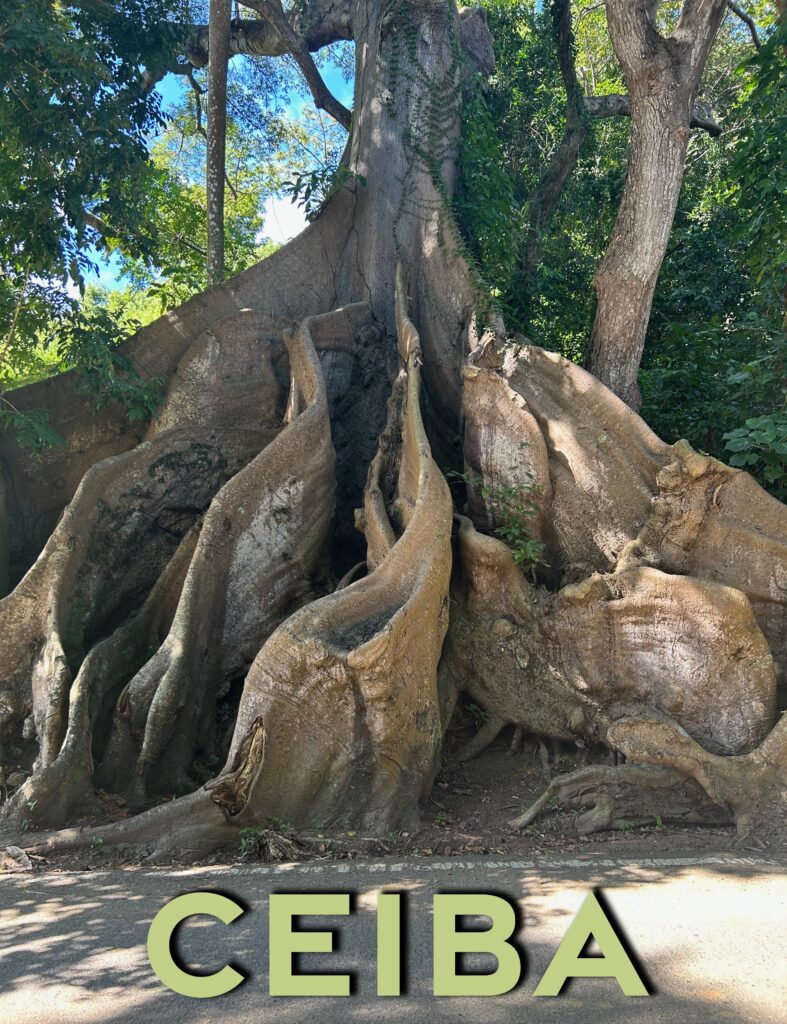
«Ceiba» is a feature-length documentary by Rubén Abruña in the production stage.
Logline
A 550 year old tree that witnessed Columbus invasion of Puerto Rico triggers writer-director Rubén Abruña to follow a trail of ceiba trees across Puerto Rico. Each one inspires awe and reverence. He meets artist and Yoruba priest Eli Barreto, who is confronted with legal pressures to cut his sacred ceiba, betraying his own religious beliefs. Rubén grapples with the intangibility of a tree’s soul and its connection to his people. Both he and Barreto discover that renewal blooms from honoring ancestors, and from spiritual and communal bonds, woven into the very fabric of our land.
Synopsis
I grew up in Puerto Rico hearing the name ceiba whispered in the wind, yet I never grasped why it inspired awe. I press my brother Fernando for answers, and he shows me an inventory of ceibas he published in 1977. That book ignited a fire in me: I felt compelled to chase those towering silhouettes 50 years into the future. To my surprise I found out how my people and the tree share a common root.
I visited the ceibas of Quebradillas, standing like cathedral columns. In the 1970’s they were marked for demolition to carve a highway, but a wave of protest saved them. This was a lesson for me. A united community can shield the ecosystems we call home.
Tucked behind a cement house, I discover a ceiba planted by Elí Barreto, artist and Yoruba priest. He regards the tree as sacred. Neighbors sue for its removal, claiming damage from its roots. Conflicting testimonies awaken me to the tensions between cultural reverence and everyday inconvenience.
Alex Santana, a reforestation specialist, remarks that Puerto Ricans regard the cutting of the ceiba as a taboo, For our people, the ceiba is a protected species.
Ethnobotanist María Benedetti reveals a living apothecary when describing the ceiba’s medicinal uses as a contraceptive, fertility aid, cough remedy, and emergency food. She leads me to Mayagüez to meet “Grandmother Ceiba, perhaps the island’s oldest. There, I am greeted by Ángel Ballester, who reminisces about Lucy who lived in the ceiba for 2 years. This encounter strengthens my sense of the ceiba’s magic.
I visit the iconic ceiba in Vieques, scarred by U.S. Navy bombings and hurricanes, yet still standing. Ardelle Ferrer has rallied legislators, securing the tree and its surroundings as a protected park, proof that vigilant stewardship can shield nature and heritage.
Dr.José Mari Mut, author of «The Ceiba Tree», clarifies that the ceiba is not legally protected or endangered, forcing me to confront how myths can shape public perception and outweigh facts in sculpting our reality.
Reviewing the ceibas and the people I met, I saw that both persist, rooted in place, honoring ancestors, continuing to thrive despite adversity, and flourishing anew. The ceiba seems to prove that endurance is woven into the fabric of our lands.
2-Page Synopsis
I, director-narrator Rubén Abruña, grew up in Puerto Rico hearing the name ceiba whispered in the wind, yet I never grasped why it inspired such awe. I press my brother Fernando for answers and he shows me a weather-worn inventory of Puerto Rican ceibas he had published in 1977 as part of an ecological collective.
The faded illustrations ignited a fire in me: I felt compelled had to chase those towering silhouettes fifty years into the future. But something else besides finding trees would eventually be revealed to me.
Following the book, I find the ceibas of Quebradillas. Their massive trunks rose like cathedral columns, their crowns brushing the sky. In the 1970’s construction crews had marked them for demolition to build a highway, but a wave of protest saved them, giving me a vivid lesson that a united community can shield the ecosystems we call home.
Hungry for the biology behind the bark, I visit a bustling nursery where Alejandro Santana tends young ceiba saplings. Under grey drizzling clouds, he shows me seedlings bristling with dagger-like thorns on their growing trunks. “These spines are armor,” he explains, “because the leaves are a banquet for hungry herbivores.” In the nursery he often hears visitors talk about how the ceiba cannot be cut and must be left untouched for fear of adverse, even fatal consequences.
I drive through the city’s grid, eyes scanning sidewalks for a lone ceiba inventoried in the book, but my search is fruitless. The urban treasure has been swallowed by massive concrete walls of a new apartment building. Modern development often regards trees as obstacles rather than silent companions.
In a small backyard tucked behind a cement house in an urban neighborhood, I discover a 25-year old ceiba, absent from the book because it was planted 27 years after publication. Its owner, Elí Barreto, artist and Yoruba priest, planted it for private religious rites. I wonder if he knew how such a massive tree would thrive in such a confined space. Now, his neighbors claim the roots damage their property and sue for its removal. Conflicting testimonies — Barreto showing no damage to his own structures versus a neighbor pointing to cracked walls and warped tiles — make me aware of the tensions between cultural reverence and everyday inconvenience.
To widen my view of the ceiba’s role, I sit with María Benedetti, an ethnobotanist and author of «Árboles nuestros para la supervivencia» (Native trees for survival). She describes some of the ceiba’s ancestral medicinal uses — as a contraceptive, fertility aid, cough remedy, and emergency food. Its silky fibers were highly valued for cushions and clothing. My eyes have been opened to the ceiba as a living apothecary, clothing and comforting human lives in challenging times.
She then leads me to “Abuela Ceiba” (grandmother ceiba) in Mayagüez, possibly the island’s largest and oldest specimen. She sings a lullaby and places flowers in one of the tree’s cavities. While there, I meet Ángel Ballester, who shows me a larger cavity that once housed a woman named Lucy for two years. Through Ángel’s testimony, I felt the ceiba’s capacity to provide shelter, protection and inspiration. He recounted how his lost wallet mysteriously reappeared at the tree’s base after he prayed to the ceiba, «his mother». This story strengthened my sense (and his) of the ceiba’s magic.
Mr. Barreto reinforces this mystique, likening the ceiba to Iroko, deity of the Yoruba pantheon. He arranges a tableau of offerings: golden yams, ripe bananas, white rum, carved gourds, glittering beads, flickering candles. He claims the tree acts as a bridge to the spirits of our ancestors, deepening my impression of its supernatural role.
An energetic volunteer crew from Para la Naturaleza, whose laughter rings across a dry hill, dig holes and plant ceibas and other native species. Their shovels strike the ground with rhythmic thuds. The sound somehow helps me to sense that planting a tree is an act of gratitude toward our ancestors and a legacy for future generations.
Continuing along the inventory’s trail, I find a ceiba in Juana Díaz adorned with a sign that reads: «Today I have another son, this tree, San. Expeditus». Its base overflows with offerings—red and orange-colored hens, silver-scaled fish wrapped in plastic, baskets of fruit, and milky bottles, showing me that modern locals still venerate this tree.
Artist Rafi Trelles, who paints colorful tropical landscapes intertwining ceiba trees with birds and humans, shows me a replica of an ancient Mayan pictograph, explaining that the ceiba links heaven (tall branches), earth (the trunk), and the underworld (roots). This mythic symbolism of trees summarizes the entire universe and resonates across many cultures, throughout all continents.
Seeking the Taíno perspective, I consult archaeologist Dr. Reniel Rodríguez at the Indigenous Ceremonial Park in Utuado, where another inventoried ceiba stands. The Carib word ceiba translates to canoe, hinting that the tree’s massive trunk once ferried families, animals, and food across local rivers and the Caribbean Sea. This, a living example of how trees play a key role in the social and economic pillars of many original cultures, as well as ours. The roots of the ceiba now threaten ancient petroglyphs in the Ceremonial Park’s ball court. Despite its importance and spiritual connection to the park, arborists recommend felling the tree to safeguard the carvings, making me suspect that a similar fate awaits Mr. Barreto’s ceiba.
Julián García, a retired forest ranger from Vieques, argues passionately for allowing ceibas to express themselves and reach their full magnitude. He is adamantly against cutting them, and challenges me to grapple with his seemingly radical position. He reminds me that trees can live without us but we cannot live without them.
While in Vieques, I visit the island’s iconic ceiba, scarred by decades of U.S. Navy bombings and battered by Hurricane María’s destructive winds, yet still standing. A true testament to its resistance and strength. Community organizer Ardelle Ferrer has rallied legislators, securing the tree and its surrounding sea as a protected natural park, proof that vigilant stewardship can shield both nature and heritage.
Mr. Barreto ultimately loses the lawsuit and has to pay for the tree’s removal. Before the chainsaw roars, he consults the Ifá oracle to guide his decision. The tree is cut, leaving a 2.5 m
stump resembling an amputated arm pointing skyward, and the neighbors cease their complaints. Grieving, Mr. Barreto turns to painting mandalas and to the rhythmic pulse of congas, his voice joining Yoruba chants with godson Giovanni Hidalgo, seeking solace through art and music.
Dr. José Mari, author of «El árbol de ceiba» (The Ceiba Tree), who has a huge specimen in his backyard often visited by tourists, warns me that many myths—such as the ceiba being legally protected or endangered—are unfounded, yet they shape public perception and education. His insights force me to confront how popular stories can outweigh facts in sculpting our reality. Two years later, Mr. Barreto’s stump sprouts a tender shoot, prompting another lawsuit from the neighbors.
To assess its vitality, I compare it to the dead ceiba from Ponce, a silent witness to Columbus’s brutal conquest of the Taínos over 500 years ago. In 1975, the U.S. Army Corps of Engineers rerouted the river near the ceiba, slicing the tree’s roots and sealing its fate, a death confirmed in 2021. But nearby, two young ceibas thrive, grown from cuttings of the fallen giant, illustrating the species’ ability to propagate, extending its lineage beyond death.
Mr. Barreto’s legal team invokes religious-freedom defenses, but the judge dismisses them, ordering the tree’s removal under penalty of jail. An arborist inspects the stump, declares the tree dead, and the case is closed. Mr. Barreto carefully places a cutting from the dead ceiba tree that has sprouted, next to the dead trunk, smiles, and prays to close the ordeal.
My brother Fernando celebrates the continuation of the work he began in 1977, when horticulturist Félix Rivera launches an internet registry of living ceibas across Puerto Rico. Visiting his farm, I meet a ceiba of about the same age as the deceased one in Mr. Barreto’s patio but with lots of open space around it. A sequence of photos depict a younger Mr. Rivera digging a hole in the ground together with his wife, dropping the red placenta from the birth of his daughter into it, and planting a small ceiba on top of it,—a poignant symbol of the intertwined destinies of humans and trees.
Reviewing all the ceibas and people I have encountered, I recognize that the ceiba and the Puerto Rican people share the same roots — Taíno, African, Caribbean — and have developed resilience in the face of ecological abuse, cultural oppression, natural disasters, and colonial bulldozers. Both the trees and the people persist, rooted in place, honoring ancestors, continuing to thrive despite adversity, and flourishing anew, proof that endurance is woven into the very fabric of our lands.